
MORE
REVIEWS of Workbook
for Wheelock's Latin
Since its
appearance in 1956, Frederic Wheelock's introductory Latin text has
remained the standard in the field, a classic in its own right. I myself
have used this work for over twenty years: as a high school freshman and
again in college; for review and reference in graduate school; and now as my
textbook of choice as a professor of Latin. Its basic premise remains as
sound as ever, namely that the optimal way to learn classical Latin is to
read the best ancient authors as soon as possible. The focus on real
classical Latin, as well as the emphasis on the philosophical and literary
culture of the Roman world, has made this text not only a primer of the
Latin language, but also a fine introduction to classical humanism and a
cornucopia of ancient authors.
Over the years, the various editions, first prepared
by Wheelock himself and then by his able successor, the eminent classicist
Richard LaFleur, have preserved the genius of Wheelock's vision, while
making improvements based upon the suggestions of generations of colleagues
and students. The sixth edition is still made up of 40 chapters with
translation exercises, additional sections of self-tutorial exercises with
answer keys, extended selections of ancient authors for further reading,
appendices containing summaries of grammatical forms, a glossary, and
grammatical index. However, recent editions have seen refinement and
expansion of grammatical explanations, the use of larger print, more
readings in continuous Latin within the chapters themselves, and helpful
sections on English etymology and Romance language derivatives. In response
to the needs and expectations of contemporary students, an enjoyable and
helpful section containing informal discussion of familiar Latin phrases et
alia has been added to each chapter, entitled Latina est gaudium et
utilis (Latin is fun and useful).
The new sixth edition continues the tradition. A fine
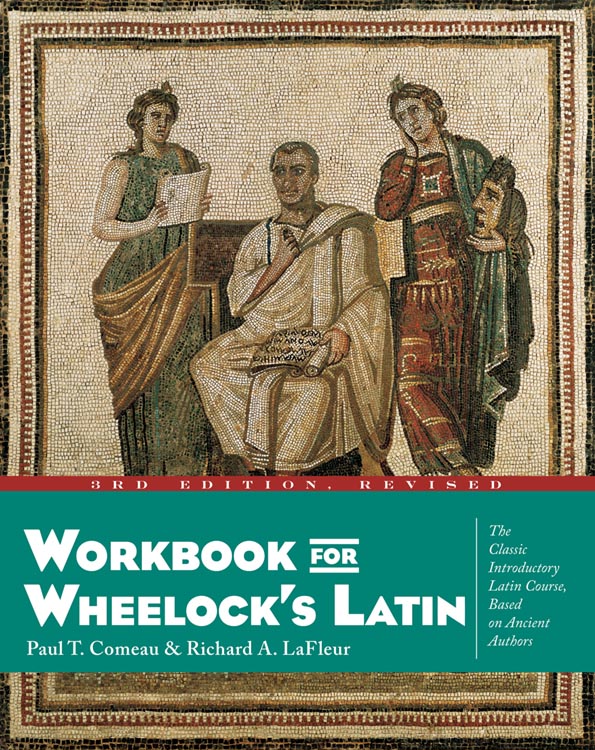
color reproduction of a mosaic of Virgil and his muse now graces the cover.
Many photographs of classical and later European art have been added to the
individual chapters, reflecting a theme from history or mythology
illustrated in the chapter readings. Three new maps, of ancient Italy,
Greece and the Aegean, and the Roman empire, respectively, have been
specially designed to include Latin names of places mentioned in the various
readings. Many of the practice exercises have been revised to better
integrate recently-learned vocabulary and syntax, and the English-Latin
vocabulary section of the glossary has been expanded.
All of these changes are welcome because they
strengthen the core of Wheelock's Latin, namely, the selections from
ancient authors. The Sententiae Antiquae in each chapter present
sources of classical wisdom with accompanying translation exercises and
introduce the student to the best authors. Furthermore, LaFleur has
amplified the already wide range of prose and poetry selections in the
chapter readings. While Cicero, Horace, and Catullus still remain at the
center of the text, the witty epigrams of Martial, Trimalchio's teary-eyed
comic recitation of his epitaph from Petronius' Satyricon (266), and
Seneca's satirical description of the Emperor Claudius' "excremental
expiration" (241) are just a few examples of the variety of authors and
genres. This wide selection, along with the fine survey of Latin literature
found in the introduction, provides students of many needs and backgrounds
with an excellent grounding in Roman literature and culture.
The second edition of a Workbook for Wheelock's
Latin is most welcome, although it must be said that the textbook itself
already contains more exercises than one can use in an average college
course. The workbook repeats much of what is already found in the
self-tutorial exercises, but arranges the material in ways more
pedagogically helpful and aesthetically appealing. The exercises are
designed not only to test vocabulary and grammar, but also to ask questions
requiring students to think about the grammar they are learning. The
workbook also does not include the answers, an important consideration when
assigning exercises for classroom and home use! The pages of the workbook
can be easily detached, and thus easily collected. The authors are to be
congratulated for producing a workbook so well integrated with the text.
Selectively used, it can enhance student understanding of grammar and
provide helpful review material.
For those long familiar with Wheelock's Latin,
the new edition shows the continuing vitality of a venerable pedagogical
classic. Likewise, those Latin teachers who remember only the earlier
editions may want to take a fresh look at what will undoubtedly continue to
be an important introductory textbook for new generations of Latin students.
–Dr. William Hyland, Assistant Professor of Classics, St. Norbert College
|
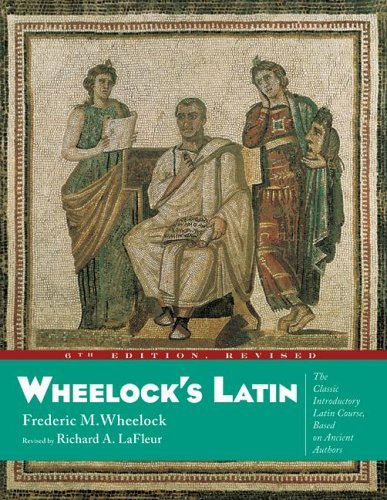
The Wheelock's Latin Series isn't complete without:
Wheelock's Latin
This standard text for
introductory Latin has been praised for its thoroughness,
organization and conciseness. This edition includes maps, photos
and more.
Wheelock's Latin Reader
Originally intended as a sequel
to Wheelock's Latin, this is the ideal text for any
intermediate-level Latin course. Read not only classical authors
but also medieval and late Latin writers.
Need a dictionary?
Collins
Gem Latin Dictionary
This best-selling Latin mini-dictionary
comes with a verbs and nouns supplement; numbers, dates and measures; plus
an index of geographical names.
Harper
Collins Latin Concise Dictionary
This is a Latin dictionary and grammar—two
books in one. It also has supplements on Roman history, life and culture;
words and phrases used in English; and more.
Don't want to study alone? Consider
joining an
online study group!
|
|
|