
CICERO'S FIRST ORATION AGAINST CATILINE
A Guided Reading
Email Dr. LaFleur: lafleur922@hotmail.com
Dr.
Richard A. LaFleur Recipient of the 2013 ACTFL Papalia Award for Excellence in Teacher Education |
|
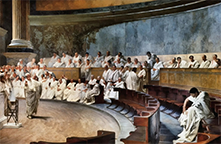 >
Welcome to the website for my tutorial, "CICERO'S FIRST ORATION AGAINST CATILINE: A Guided Reading"
SALVETE, VOS OMNES!! This is the site for my online guided reading of selections from Cicero's first Catilinarian oration.
This is an independent self-paced tutorial for adult learners with a strong background in Latin, including ordinarily my full curriculum of tutorials: WHEELOCK'S LATIN (Latin I-II), Ovid, Vergil, Juvenal, Cicero's DE SENECTUTE, and Catullus, or a reasonably comprehensive equivalent.
This directed reading, like my other tutorials, is asynchronous and highly personalized; we will proceed one section at a time through to the end. Procedures for the tutorial are linked here.
The recommended texts are:
- CICERO’S FIRST CATILINARIAN ORATION, with Introduction, Running Vocabularies and Notes, by Karl Frerichs (Author), Robert W. Cape (Foreword), available here.
-
CICERO’S FIRST CATILINARIAN, by Geoffrey D. Steadman, Latin Text with Facing Vocabulary and Commentary, free online here or as an inexpensive paperback here.
- The LOEB CLASSICAL LIBRARY edition + translation, CICERO ORATIONS: In Catilinam 1–4, Pro Murena, Pro Sulla, Pro Flacco, by C. McDonald, available at various sites online including here.
If you think you may be interested in applying for this course of study, please email me for further information.
R. A. (“Rick”) LaFleur, aka Doctor Illa Flora
TESTIMONIUM
I took up studying Latin in my 60s shortly before retiring. I wanted to keep my mind active into old age and hopefully reduce the chances of dementia creeping up on me as happens to so many people these days.
I chose Latin for two reasons. Firstly: I wanted something that would really challenge me intellectually. Being more of a scientist and definitely not a natural linguist, having hated my brief introduction to Latin at school (probably due to poor teaching), Latin seemed a good choice. Secondly: I had always been interested in etymology, and as Latin is the root of so many words in the English dictionary, I now had further confirmation that I was making a good choice.
I cannot remember exactly how my collaboration with Rick started; maybe it was the publisher who made me aware when I first bought Wheelock’s Latin, but he has now been my distance learning coach for quite a few years.
I am so, so glad I did reach out to him because he has turned out to be an absolute diamond. His tireless enthusiasm for his subject is highly infectious and his endless patience has helped me out of some learning predicaments many times.
We worked through the whole of Wheelock’s Latin together, but we weren’t just learning the language. Rick’s curriculum ensured there was a really interesting mix of supporting Roman history, both political and social.
There were numerous snippets of real Latin text to study too: epitaphs, graffiti, excerpts from Latin poetry et cetera. It was a really interesting and immersive way to learn the language.
Once I had my certificate for completing the basic Wheelock’s course, Rick asked me if I wanted to progress further, and this is where the real journey began. We started studying Latin poetry studying work by Ovid and Vergil and the father of modern satire: Juvenal.
I had signed up for an intellectual challenge and, by Jove, I now had one. In Latin poetry word order is almost completely irrelevant and in some textbooks insufficient punctuation. Every line or verse has to comply with some form of rigorous meter: dactylic hexameter, hendecasyllabic, choliambic to name but a few. I was taught by Rick how to scan all these different meters.
I have been acquiring new skills all the time plus an understanding of the myriad terms for different rhetorical devices employed by the poets. I even discovered that the poets sometimes placed the words in a particular order to create actual ‘word pictures’.
Some of their work, Juvenal’s for example, was even multi-layered with multiple embedded messages. All this new knowledge imbued in me a profound respect for these ancient poets. How remarkably clever and talented they must have been writing and rewriting their work to not only fit the meter but actually sound interesting when it was recited with rhyming and other sound effects. All Latin poetry was recited out loud and not read in silence.
Juvenal’s satires provided an extraordinary insight into real Roman life: the corruption, moral depravity and abuse of fellow human beings was eye watering. After Juvenal we spent some time away from poetry studying Cicero’s remarkable work De Senectute (About Old Age).
We are now just completing our latest collaboration: translating and unravelling the messages contained in the poems by Catullus, who spent his life in a love-hate relationship with his Lesbia. There are both some really beautiful and highly emotional works in that collection.
Our next assignment, which I am looking forward to enormously, is another work by the Roman legend that was Cicero. This time it is a transcript of one of his speeches in the forum denouncing the evil Catiline.
Although we rarely speak on the phone and conduct nearly all our communication by e-mail, Rick has become a great friend and I feel I know a lot about him, his life and his family.
Although I am now doing more advanced work than most Latin university students, I don’t think I will ever be able to read Latin fluently, but I love the challenge of seeing a new piece of Latin text and starting to de-code it, and I wish to keep collaborating with Rick for as long I can.
Adam Clay, Scotland
| TOP OF DOCUMENT |
Last updated 11/26. Please report any problems with this website to lafleur922@hotmail.com